Why Should Children Be Encouraged To Play Football?


The benefits for young boys and girls of playing football are many and the benefits can be seen both on and off the football pitch. From fitness to social interaction and life skills football provides an unusual, but ideal, training ground for later life.

In today’s media we are constantly being reminded of a health time bomb that is about to explode as children today are not active enough.

There are so many competing distractions for our children’s attention, video games, endless channels to watch, these can all lead to Football  is the beautiful game, played by millions of young girls and boys (aged 6 to 18) across many continents, whether it’s on the beaches of Rio, the back alleys of a major city nearby or the local park, you will find someone kicking a football around.

In today’s society there has been a shift to more organized football practice for our youth players. Gone are the days of jumpers for goal posts, as streets are littered with cars and grass verges now have houses built on them.

Having a more structured approach is both a good and a bad thing; on one hand young players get structured development and education through willing volunteers who show them how everything from how to warm up correctly, develop their technical ability with the ball right through to skill development and organized small sided games to wrap everything up together to offer a total learning experience.

Today time is limited and there may be only an hour or two devoted to structured soccer practice during the week, what happens when practice is over? Getting your child to take part in an organized football school or club can bring tremendous benefits to you and your child.

Football can help increase your child’s self-esteem, which feeds their self talk which ultimately drives their performance. But football isn’t the only winner, quite often it can be seen that academic performance can increases too! Studies have shown that getting young children involved in football at an early stage promotes a real healthy attitude towards the game and this attitude continues with them into adult life.

Stage Equipe de France Chris Bonzon

The number one reason why children play football is to have fun; if football is fun and enjoyable then players will want to continue playing. This benefits their overall fitness and reduces their health risks considerably.

Soccer is made fun by coaches worldwide who willingly give up their time voluntarily to organize Youth Football practice and coach teams.

Gone are the days when football, for the really young players, was an 11 a side game with offside rules and no touches of the ball for massive periods of the game.

Youth soccer from the age of 6 to 11 is typically about having fun, playing small sided matches such as 4 v 4 with no goal keepers, promoting lots of touches of the ball and player interaction on the pitch.

Through playing football and encouraging children to take regular exercise many of the risk factors that are associated with heart disease such as obesity and diabetes can be reduced much. It is stated that childhood obesity has increased by more than 50% since 1976, which is a really scary fact.

Getting your child involved in soccer doesn’t just improve their health. We’ve mentioned already the improvements at school.

Social benefits, such as mixing with others, having to work as a team, contributing through personal effort to a collective goal, experiencing the highs and lows, picking each other up, competition, striving to be the best, aiming to win and supporting and helping others are all by products of playing football.

Many of the life skills that the players learn through football are beneficial in later life, how to form and build relationships, developing a sense of co-operation, how to lead people, how to handle adversity, what commitment means and punctuality, are all key qualities that will benefit the players in adult life.

soccer_back

If your child is already playing football, great, but what  can you do if you want to get your child involved in a local team? Here are seven must ask questions that you and your child should consider when attempting to find a suitable club…

1) What level of commitment is required in terms of practice sessions and games at the weekend?

2) When are the training sessions? When are games played, what’s the format and how much time will you need to devote?

3) How far are you willing to travel to training and to matches? Some clubs will run travel teams where distances can be much, including overnight stops.

4) What are the costs involved? Some clubs adopt a pay when you play, others a more structured approach. The most expensive clubs are not always the best, ask yourself is what you’re paying in the equal to what your child is getting out?

5) What do you and your child want out of playing football? This needs to be aligned with the prospective club’s philosophy, is it about having fun or winning?

6) How best will your child learn, develop and stay interested? Are they happy just to be involved or would they thrive in a more competitive environment?

7) What is the club’s constitution and philosophy to football, how long have they been in existence, the experience of the coaches, site, facilities etc.

Once you have considered the above questions what are your next steps to finding a suitable club or football organization for your child?

You can…

i) Get in touch with your local football association by searching the web or looking in yellow pages. They should be able to give you a list of clubs and organizations in your local area.

ii) Ask other parents/guardians about local junior and youth football teams. You’ll be surprised at how many adults or their children are involved.

iii) Encourage you children to ask their school mates where they play their football. Knowing some of the team can be a real advantage as players integrate themselves into a team.

iv) Ask your child’s form tutor or headmaster if they know of any clubs or organizations. Many clubs have formed good relationships with the schools over the years.

v) Read the local papers or local news websites you’ll be amazed at how much coverage youth and junior football gets.

These five practical steps should enable you to find a club that meets yours and your kid’s football aspirations. However, if there still isn’t a club near you that can satisfy a need why not look to set up your own team!


Author: Neil Stafford
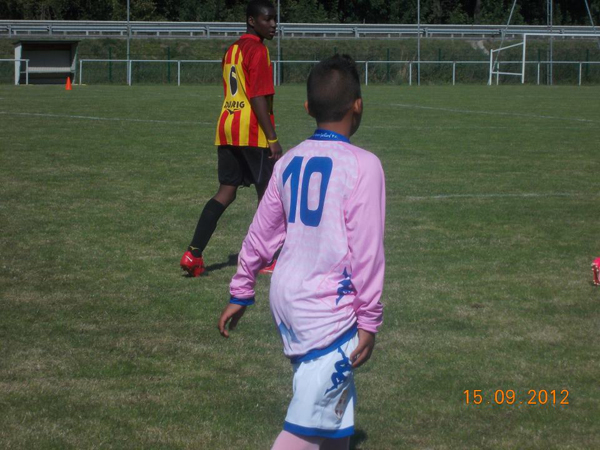


It’s all in the number


When it comes to football, shirt numbers give away a player’s stature and importance in the team. Everything is determined by the number, even mindset and performance! After all, there’s a legacy, an inheritance attached to shirt numbers that cannot be denied. This tradition is so deeply etched in every football fan and player’s mind that wearing a number associated with past legends comes with its own set of expectations.

Football shirt numbers were once closely associated with the place one played. To the extent that positions were actually referred to by shirt number! This meant that a player’s number changed with each match, depending on which position was assigned to him on that particular day. The numbers 1 and 12 were usually kept for goalkeepers, 5 for a center midfielder, 9 for a striker, 11 for a left winger and number 10 for an attacking midfielder.
Chris Bonzon playing defender
Things changed during the 1954 World Cup when FIFA laid down the rule that teams had to use a numbering system. A specific shirt number was to be given to each player for the entire tournament but  that was then and this is now…

With the numbering system of 1 to 11 relegated to the past, on the world stage, teams usually stick to the numbers 1 to 23, though a few exceptions. At the club level, any number from 1 to 99 can be worn. So, you have random numbers at play – numbers that players consider lucky or their favorite player’s numbers worn as a mark of respect.

Players now lay claim to certain numbers and jealously guard them. Only players that seem worthy of continuing a legacy are allocated the much coveted numbers 7, 9 and 10. They have history to back them up and have become synonymous with football legends. But the biggest honor goes to the number 10, given to the most creative play maker on the field that scores the maximum goals. The number 10 football  jersey has graced the shoulders of Pele, Diego Maradona, Michel Platini, Zico, Lothar Matth¤us, Gary Lineker, Roberto Baggio, Zinedine Zidane, Michael Owen, Juan Román Riquelme, Francesco Totti, Alessandro Del Piero, Ruud Van Nistelrooy, Rivaldo, Ronaldinho, Van der Vaart, Wayne Rooney, Kaka and Lionel Messi.

Bobby Charlton, Ian Rush, Fornando Torres and Alan Shearer are famous number 9’s. More recently, the lethal Brazilian forward Ronaldo did full justice to the number 9. Iconic number 7’s are David Villa, Raul Gonzalez, Franck Ribery, Luis Figo, George Best, Eric Cantona, Juanito, Amaro, David Beckham, Cristiano Ronaldo, Bastian Schweinsteiger and Andriy Schevchenk.

Then, of course, you’ve got certain players who adopted their own unique numbers and made them their trademark. The legend Johan Cruyff took a liking to number 14 and wore it instead of the number 1 that should have been assigned to him. David Beckham chose 23 and made it the most sought out for number on the field! Recently, Ronaldinho selected number 80 based on the year of his birth.

There’s no doubt that generations to come will associate these numbers with football greats. They’ll be worn with a sense of pride, driving each player to deliver an inspired performance that does the number on his back proud.

Exploring the Benefits of Football Training for Children


As parents, we want our children to pursue healthy activities and make the right lifestyle choices. We often encourage them to become actively involved in sports and other extra curricular activities. Many children may decide to take part in a football training program that will develop them for football team play. In this article, we will take a look at the benefits of football training for children to help you decide if this choice is right for your child.

The first thing you should consider when evaluating the benefits of football training for children is the impact that it will have on their personal health and overall fitness.Football  training is often physically challenging and provides a good workout to children. There are many games and activities that are introduced to children during football  training that helps to work out various parts of their bodies. If a child is interested in playing on a football team, these games and activities will help to personally develop them as a player. Many skills and techniques are established during this particular type of training. This can be a fun, physical activity for children. Possibly even an experience that they will remember the rest of their lives.

The second thing that you should consider when researching the benefits of football  training for children is that it can be an excellent way to help children develop a self-image that is positive. Sports training and activities help a child to realize that they have a unique set of talents and skills that they can use for the greater good of the team. They learn to understand that they are an essential part of the team, and without their unique talents and skills the entire team can suffer. They are important, and they know it. Football  training can aid a child in developing this excellent self-image.

The third thing that you should consider when exploring the benefits of football  training for children is that it is a great way to help a child grow socially. Children will interact with other children their age, as well as many adults such as coaches and other parents. They will learn many social obligations, such as the importance of a chain of command, being polite, being respectful, sharing, and how they are the same and different from others.

When a child engages in football  training, they begin to understand the importance of being part of a team and sharing success and failures with others. In order for a child to grow as a mature and emotionally stable adult, need to that they learn how to handle stress, success, failure, and interact appropriately with others. Football  training is a great way to begin all of these important lessons.

As you can see, there are many benefits to allowing a child to actively participate in football Youth Football Camp training. Not only can it help develop the playing abilities of the child, but it can help in the emotional, social, and academic progression of the child.

Creating A Room For A Football Fan


If you have a child or even a husband who is obsessed by football, you can make their own room and surprise them. If it’s your child you can switch their room into a fantasy football room that they could have never imagined. With a husband unless you want to change your bedroom around, maybe decorate the den for him.

A great way to start out a room for a football fan is to paint it. Now you should pick the colors of the team your child loves best. It’s a very easy project in fact most stores that sell paint will be able to help you pick out just the right colors for this job. But if your child doesn’t have a team but just loves the game try something different. Paint the bottom part of the walls in a green color that looks like turf. The top of the wall you can add a nice blue for sky, and if you want to expand on the look add in a few clouds also.

They have those fantastic looking player pictures that you can buy and place on the wall, or even hire a person to paint a picture of your child’s favorite player. Don’t forget to place up some goal posts to finish off the perfect look on the walls. Even adding people sitting in stadium chairs if you want to go that far.

Buy a comforter that is the colors of a team or a football theme. This shouldn’t be hard to find and is just another way to make the theme complete and perfect.

Don’t forget to place an area rug into the room. This will give your child a softer place to land when they and friends are playing football in the room. Plus it will also help to keep the noise down. Don’t forget to get a rug that goes with the theme of the room. You can either get one that has something to do with football on it, or a team logo again.

Picking out an area rug for the room you can pick a football theme, or again a team that your child seems to like the most. This will not only help the look of the room, but also provide a soft place where you child to sit and play, and it will cut down on the noise coming from the room. You don’t need to spend a ton of money on a good rug if your child is younger and may wear through it quicker.

Don’t forget to put in some footballs into the room. Have a storage bin that is shaped like a football to place them in when he’s not using them.

Placing real footballs in the room will be a nice finish to a football haven. Be sure you have someplace where you child can store these items when they aren’t being used. This type of room will drive your football fan wild; a great way to create a special room for your child. Don’t forget to try and surprise your child with this redecorating project.

Maybe one weekend when they can spend some time with a friend, always employ outside help to surprise a child if you can. Get that perfect football room set up today.

Author: Abbie Osborne-Wilsonbedroom for a football  fan